
Provider Scoring & Selection
The Scoring Layer evaluates every candidate provider and model against the current workload, strategy, and workspace constraints. It produces a ranked candidate list that the Execution Engine uses to route requests.

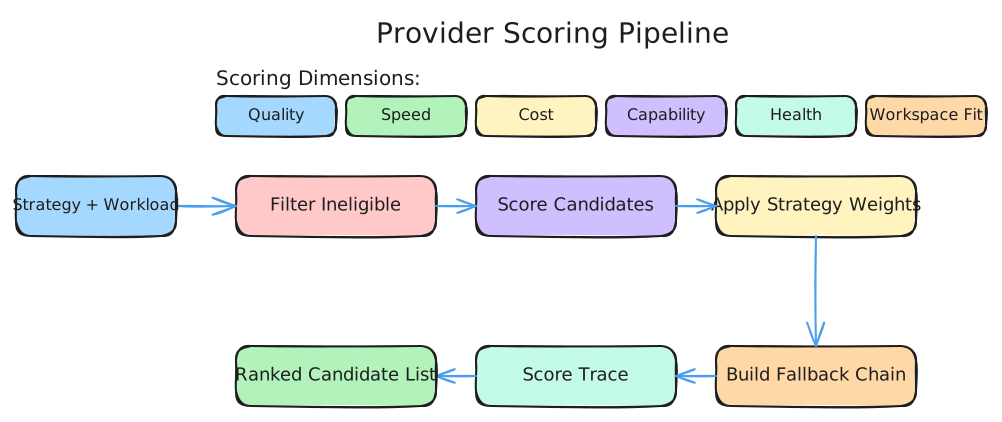
Scoring Dimensions
Section titled “Scoring Dimensions”| Dimension | Weight Source | Key Function |
|---|---|---|
| Quality Score | Model capability + historical accuracy | scoreProviderReliability() in evaluation/quality/engine.ts |
| Speed Score | Historical latency p50/p99 | scoreOneCandidate() in scoring/runtimeScorer.ts |
| Cost Score | Token price × estimated output size | scoreCandidate() in scoring/scorer.ts |
| Capability Match | Does model support the required features? | resolveCapabilities() in routing/enrichment.ts |
| Health Score | Current provider uptime / recent errors | Provider health aggregator |
| Workspace Fit | User preference + historical satisfaction | workspaceFit in capabilityModel.ts |
The Scoring Pipeline
Section titled “The Scoring Pipeline”Strategy + Workload + Provider Pool | v[1] Filter Ineligible --> Remove providers that don't support required features | v[2] Score Candidates --> Score each remaining provider across dimensions | v[3] Apply Strategy Weights -> Weight scores by strategy priority (cost/speed/quality) | v[4] Build Fallback Chain --> Ordered list: primary, backup1, backup2... | v[5] Score Trace --> Record scores for explainability and learningRuntime Scoring
Section titled “Runtime Scoring”The runtime scorer (scoring/runtimeScorer.ts) does fast, per-request scoring:
function scoreOneCandidate(  candidate: ProviderCandidate,  workload: WorkloadProfile,  strategy: Strategy,  telemetry: ProviderTelemetry): ScoreResult {  const quality = scoreQuality(candidate, workload);  const speed = scoreSpeed(candidate, telemetry);  const cost = scoreCost(candidate, workload, strategy);  const health = scoreHealth(candidate, telemetry);  const fit = scoreWorkspaceFit(candidate, workspace);
  return weightedAggregate(quality, speed, cost, health, fit, strategy.weights);}
Quality Scoring Engine
Section titled “Quality Scoring Engine”The quality engine (evaluation/quality/engine.ts) provides deep quality analysis:
| Function | Purpose |
|---|---|
scoreProviderReliability() | Aggregates historical success rate, error rate, retry rate |
scoreStrategyEffectiveness() | Measures how well a strategy performs for a provider |
computeTraceConfidence() | Confidence score for a single execution trace |
buildAggregateExplanations() | Builds human-readable explanations for quality scores |
Fallback Chain Construction
Section titled “Fallback Chain Construction”The fallback builder (orchestration/fallback.ts) creates the ordered chain:
scoreDeltas() --> Compare candidate scoresscoredOrder() --> Sort by composite scorescoreBuiltFallbackChain() --> Build chain with diversity rulesDiversity rules ensure the fallback chain isn’t just “the same provider three times”:
- Provider diversity: Primary and backup must be different providers where possible
- Model diversity: Different model families for resilience
- Geographic diversity: Different regions for availability
- Tier diversity: Mix of premium and standard models
File Reference
Section titled “File Reference”| File | What It Does |
|---|---|
scoring/scorer.ts | Core scoring logic. Aggregates all dimension scores |
scoring/runtimeScorer.ts | Fast per-request runtime scoring |
scoring/profiles.ts | Scoring profiles per strategy and workload type |
evaluation/quality/engine.ts | Deep quality analysis and historical aggregation |
orchestration/fallback.ts | Fallback chain construction and delta analysis |
providers/capabilities.ts | Provider capability definitions and matching |
src/features/providers/capabilities/capabilityModel.ts | Frontend capability matrix data model |
Integration
Section titled “Integration”- Strategy Engine → provides weights
- Workload Analysis → provides estimated token counts and complexity
- Provider Registry → provides available providers and metadata
- Provider Health → provides real-time health telemetry
- Execution Engine → receives the ordered candidate list
- Explainability → receives score breakdowns for transparency